Rex Fisher's logbook
The Passage (Justin Cronin Edition)Rex Fisher's logbook is both a technical record and an archive of the First Colony’s severed connections to the outside world. Michael Fisher discovers in its pages hundreds of reports from distant places, ending with the order that all transmissions cease; the notebook makes the loss of communication legible and prompts Michael to ask how a radio might be built again.
Identity and Contents
The notebook bears the name Rex Fisher, identified as Michael Fisher’s great-grandfather—or perhaps great-great-grandfather—and as First Engineer of Light and Power for the First Colony, California Republic. Its narrow black spine had sat among the clutter above Michael’s monitor, between a spool of solder and Elton’s CDs, yet Michael cannot remember noticing it before. The aged pages, crinkled with moisture, reveal an organized log rather than a personal memoir.
Its entries pair dates in the old style with hours and transmission frequencies, followed by terse notes. Phrases such as “unmanned distress beacon,” “five survivors,” and “military?” condense the traces of emergencies and possible encounters into a few words. Place names include Ogden, Utah; Kerrville, Texas; Las Cruces, New Mexico; and Ashland, Oregon. Hundreds of such notations fill the pages, preserving a broad but fragmentary map of communications.
Discovery and Interpretation
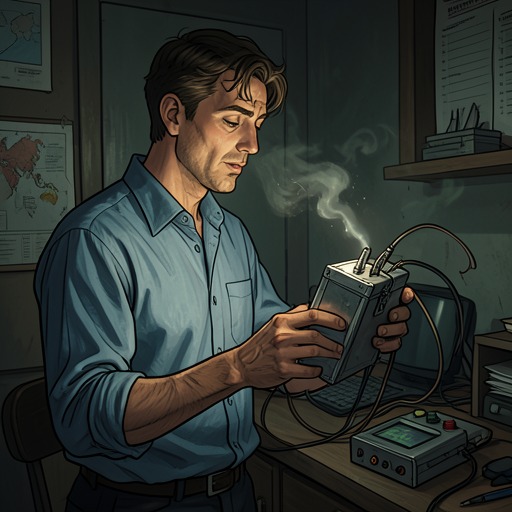
Michael finds the log during the quiet hour before dawn while working at the Lighthouse panel. He has been monitoring the equipment and, having exhausted his reading, leafing through Teacher’s copy of What to Name the Baby. The sudden sight of an unread book draws him from his chair; recognizing Rex Fisher’s name, he quickly parses the columns and their significance.
The last entry is starkly different from the many brief reports that precede it: “All transmission ceasing by order of the Household.” The line records not merely a fading signal but a deliberate institutional cutoff. Michael finishes reading as Morning Bell begins, then powers down the lights and carries on with the routine that keeps the Colony functioning. The log’s discovery therefore arrives in the middle of ordinary maintenance, linking the former network of distant voices to a present in which every night’s light must be carefully managed.
Radio and the Lost Network
Michael shows the notebook to Elton, who recognizes it as the logbook of Michael’s great-grandfather and says it has been circulating in the Colony for years, though he has never read it himself. Elton’s uncertainty leaves the log’s earlier history unexplained, but its contents give Michael a reason to seek practical knowledge. After absorbing another secret, Michael asks how to build a radio.
Elton explains that the radio itself is not the obstacle; the mountain is. The original beacon depended on an antenna at the peak, connected to the transmitter in the Lighthouse by an insulated cable five kilometers long. Both the antenna and cable had been taken down and destroyed under the One Law. Without the antenna, the Colony is blocked to the east, and any signal it might receive would be overwhelmed by electromagnetic interference from the battery stack. The log preserves the evidence of communication, while the destroyed infrastructure explains why that history cannot simply be resumed.
Significance
The notebook changes the scale of Michael’s world. Its compact notations point beyond the lights and rooms of the Colony to survivors, distress calls, and places spread across the continent; its final line shows that silence was imposed by an order, not simply produced by distance. As a material object hidden in plain sight, it reconnects a present-day engineer to his ancestor’s work and turns inherited knowledge into a question about what the Colony chose to abandon—and whether contact can be restored.